
Josda Settlement
Give clients and families a better way through estate settlement.
Settling an estate puts unfamiliar financial, legal, administrative, and practical responsibilities onto the person expected to act.
Attorneys, accountants, financial advisors, and other professionals can provide essential help. But much of the work of actually administering the estate still belongs to the personal representative and family.
Josda Settlement gives them a guided process for understanding what matters now, completing the work, getting help when they need it, and knowing what comes next — while giving the advisor a practical way to remain connected and useful without becoming the estate’s project manager.
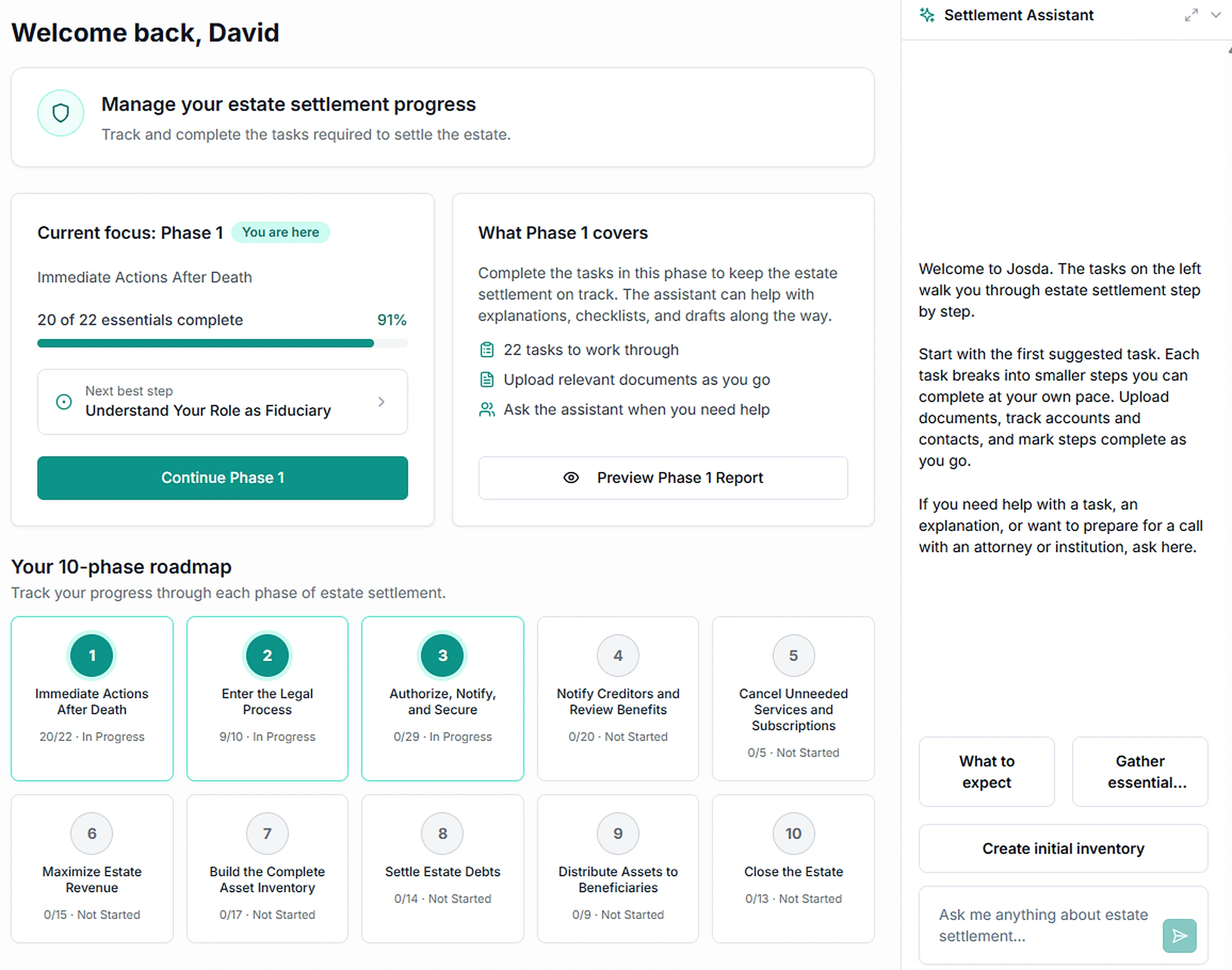
The work after the documents
Professional help does not make the family’s work disappear.
The problem is not simply that there are a lot of tasks.
Estate counsel can guide the legal process. Accountants can handle important tax work. Advisors can help with accounts, investments, insurance, liquidity, and other financial questions. But the person responsible for the estate still has work to do.
Someone who may never have settled an estate before suddenly has to understand how the pieces fit together and keep the process moving.
What still belongs to the family
Gather records
Locate and protect property
Work with financial institutions
Understand assets and debts
Manage ongoing expenses
Coordinate professionals
Track administrative requirements
Communicate with family members
Maintain a record of what has been done
The family may inherit the responsibility. They shouldn’t have to invent the process.
A natural extension of holistic planning
The advisor doesn’t have to settle the estate to give the family a better way to do it.
Settlement is where many of those decisions have to work in the real world.
Advisors already help clients think about ownership, beneficiary designations, insurance, liquidity, estate documents, wealth transfer, family preparedness, and the people who may eventually need to act.
Giving a client or family a better tool for navigating that transition is not the same as asking the advisor to administer the estate.
Help a client who is settling an estate today
A client may become the personal representative for a parent, spouse, sibling, or someone else. The firm can give that client a purpose-built process for working through the responsibility instead of sending them away with a checklist and a collection of referrals.
Better equip the people who may someday settle the client's own estate
If the firm's client dies, a spouse, child, executor, trustee, heir, or other representative can have a structured way to work through what follows.
Stay connected where the advisor is useful
The advisor can remain available for accounts, investments, liquidity, insurance, financial decisions, and coordination with the other professionals involved.
Support the process without becoming the process
The person settling the estate has a tool for organizing and completing the work instead of routing every task and procedural question through the advisor.
Providing a better way through the transition is part of serving the financial life around the client — even when the advisor is not the person doing the work.
A better standard
A settlement tool should do more than tell someone everything they might have to do.
A comprehensive checklist can be useful. But when someone is actually responsible for an estate, they need more than a catalog of possible tasks.
A better process should help them understand the estate in front of them, focus on what matters now, make progress in a useful sequence, understand how to complete the work, get help when questions arise, and know when the right professional belongs in the conversation.
Give the person responsible an actual process
Information about estate settlement is not the same thing as a system for working through it.
Start with what is already known
Do not make the family rediscover information that was already organized before death or already gathered during the settlement.
Surface the work that matters
The person responsible should not have to sort through every task that could possibly apply to another estate.
Adapt as the estate becomes clearer
Information learned during the process should shape the work that appears later.
Make the next priority clear
A person facing dozens of responsibilities should be able to understand what deserves attention now.
Help the user understand how to do the work
Knowing that a task exists is not the same as knowing how to complete it.
Put help where questions arise
Routine uncertainty should not force the user to stop the work, search the internet, or call the advisor every time something is unfamiliar.
Keep information connected to the process
Information gathered while settling the estate should remain useful as the work continues rather than being scattered across separate notes, spreadsheets, and files.
Bring professionals in where they belong
The process should complement attorneys, accountants, advisors, insurance professionals, and others rather than pretending software replaces them.
Preserve progress and context
Settlement can take months or longer. The user should be able to return without reconstructing what happened the last time they worked on the estate.
Let the advisor support without administering
A firm should be able to provide meaningful assistance without taking responsibility for managing every estate task.
That is the standard Josda Settlement is designed around.
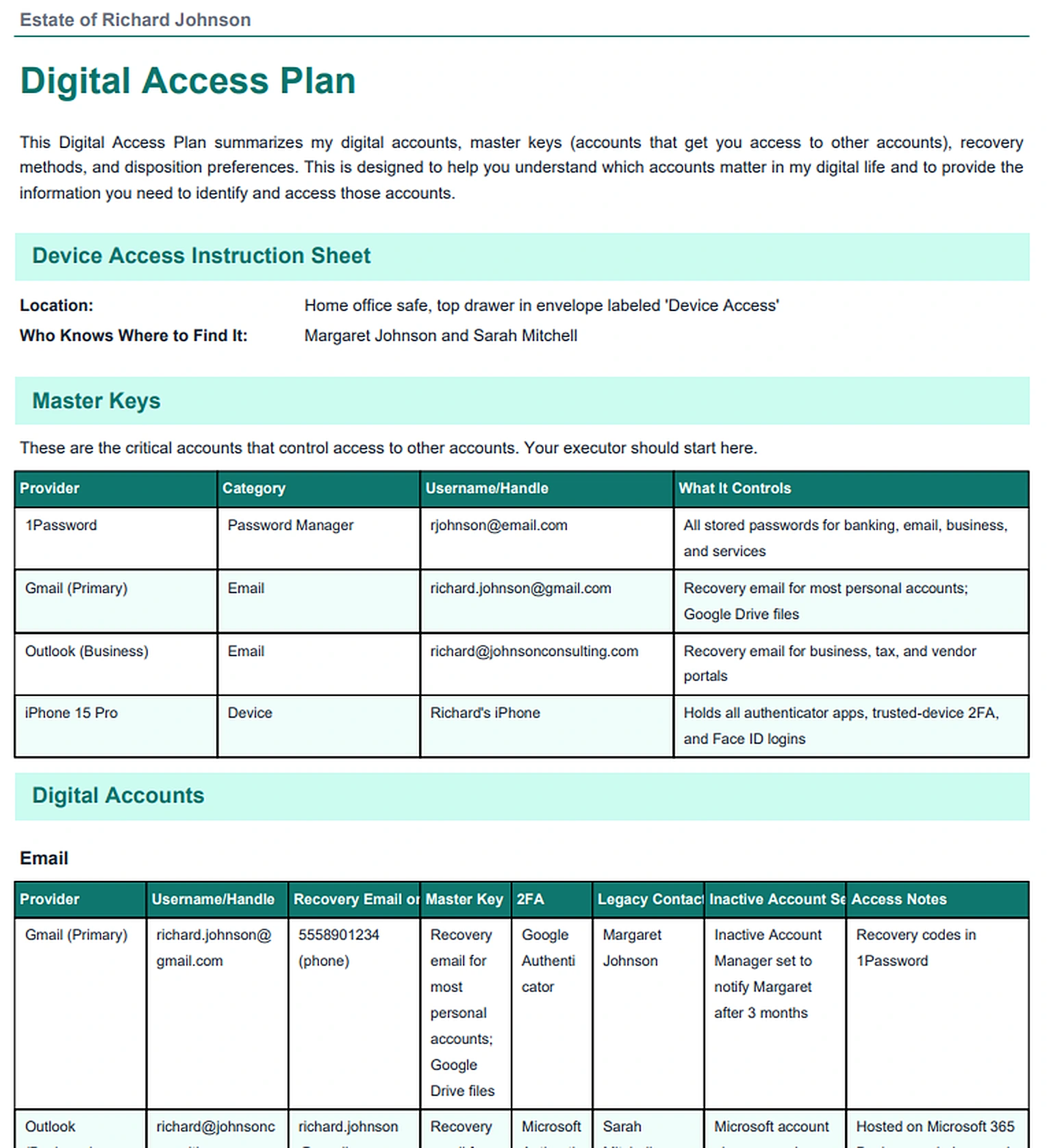
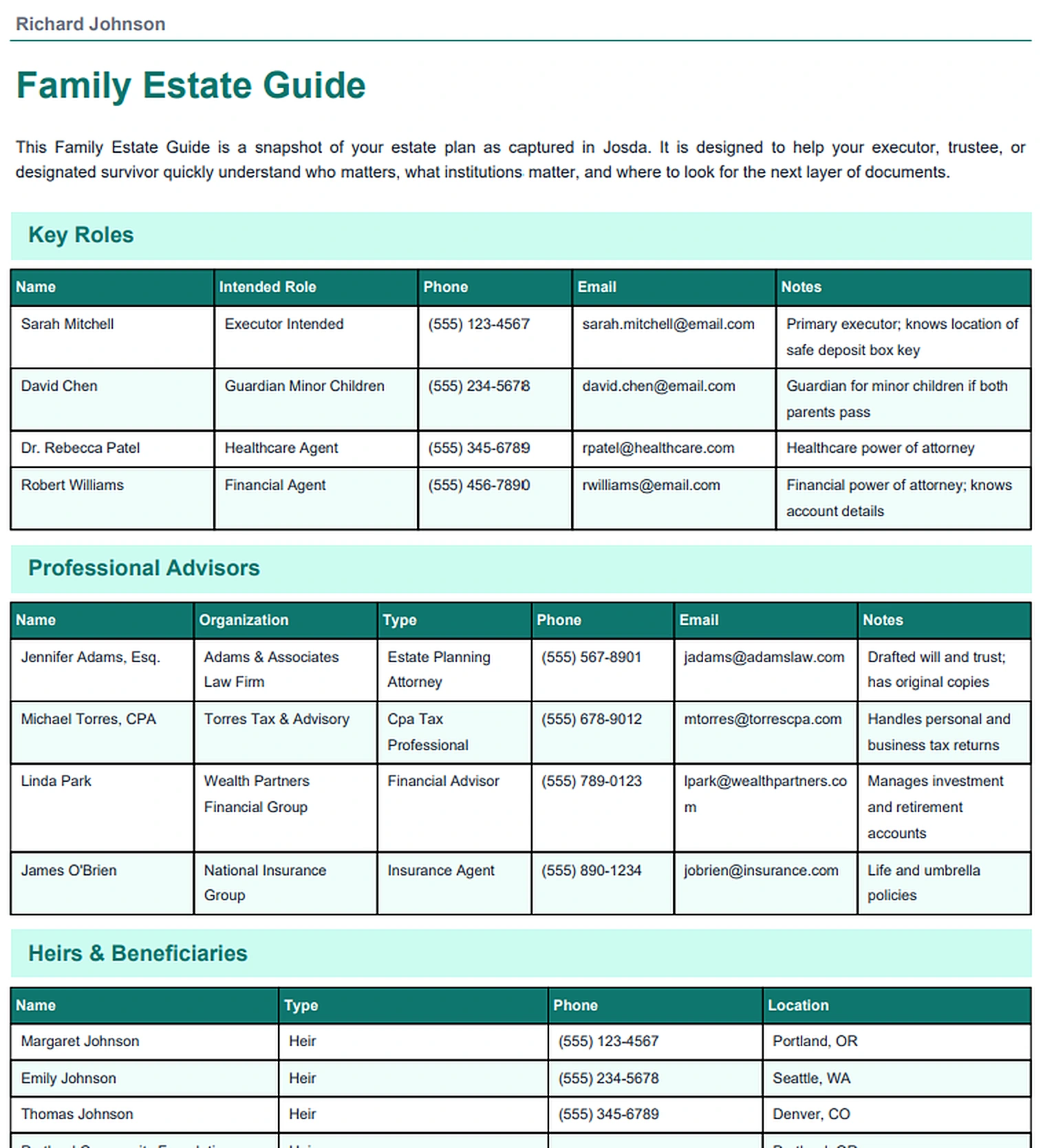
Start with what’s already known
The family should not have to rediscover the estate after the person dies.
One of the hardest parts of settlement can begin before the first task is completed: figuring out what exists, who is involved, and where important information can be found.
Accounts. Assets. Debts. Insurance. Property. Documents. Important people. Professional relationships. Other information needed to understand the estate.
When useful information has already been organized through Josda Planning, that work can provide a stronger starting point for the people who later need to act.
And as Settlement progresses, information gathered through the work can remain part of the estate picture rather than disappearing into disconnected notes, spreadsheets, emails, and folders.
Good planning should make settlement easier.
A structured roadmap
See the process without having to understand all of it at once.
Structure should reduce uncertainty, not create more of it.
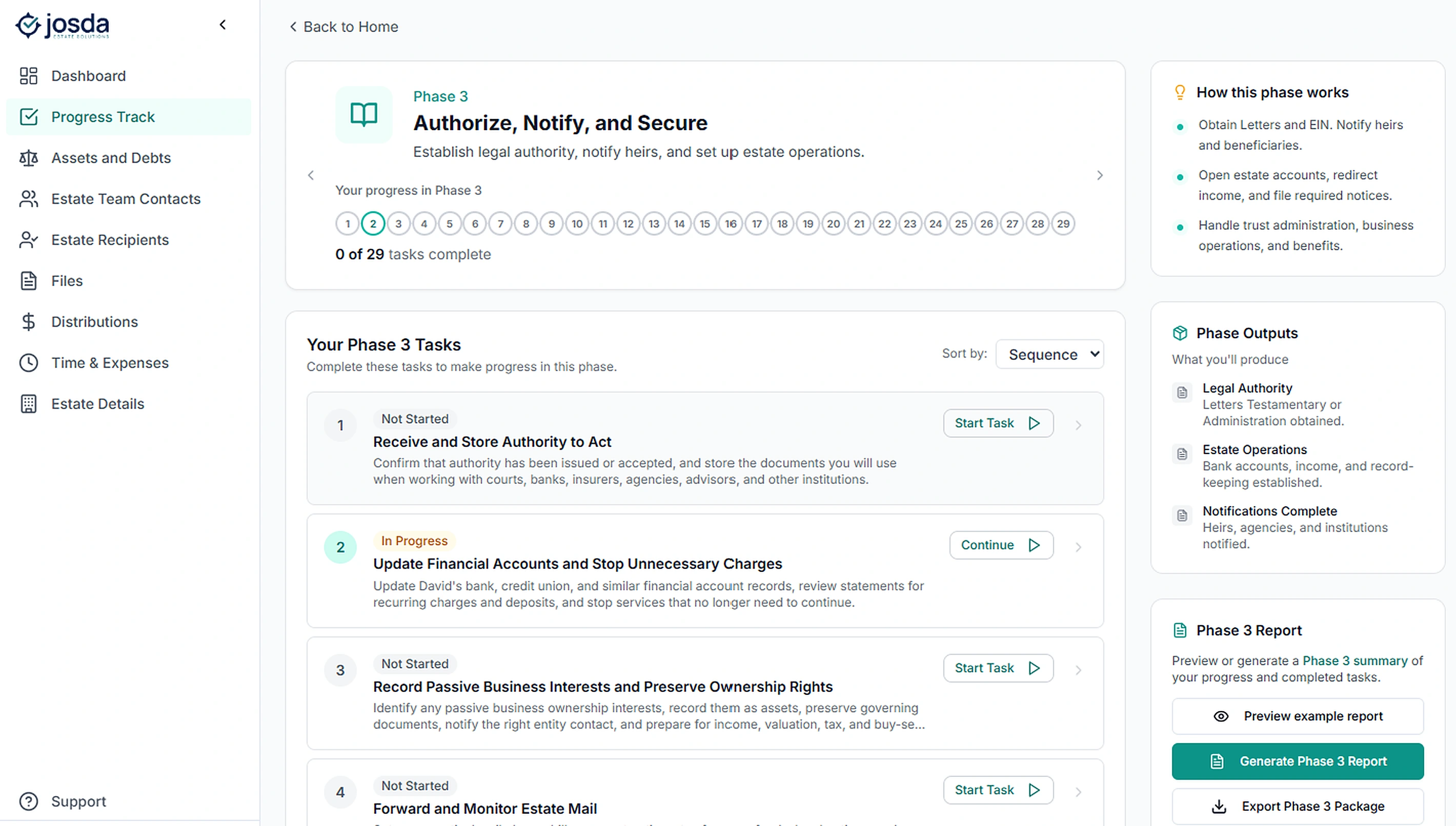
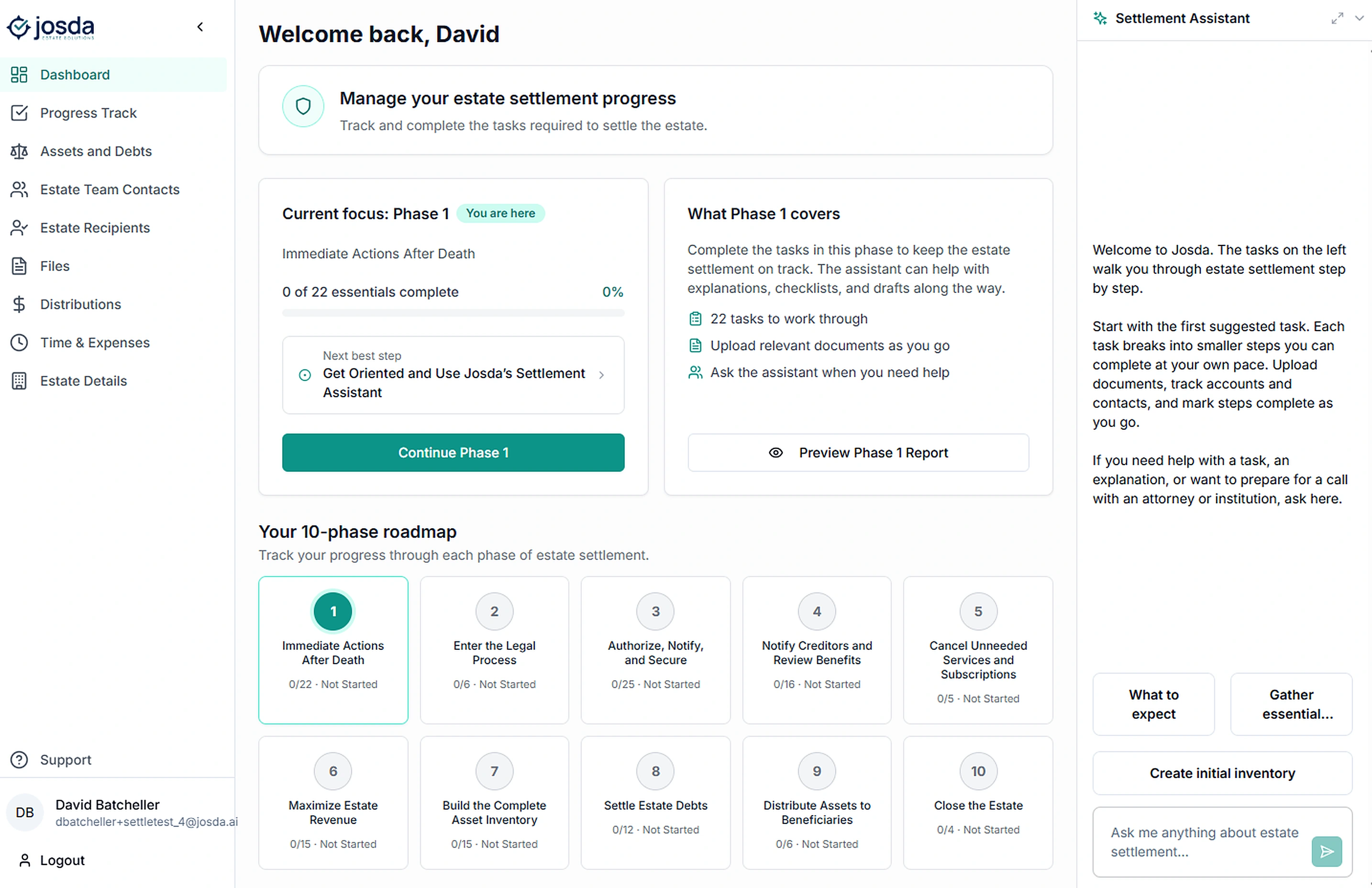
Someone settling an estate needs to understand that there is a larger process — but they should not have to become an estate-administration expert before they can begin. Josda Settlement organizes the work into a structured roadmap that helps the user see where they are, what they are working on, and how that work fits into the broader settlement.
Instead of confronting an undifferentiated list of responsibilities, the person settling the estate can work through manageable areas of the process while maintaining a clear sense of overall progress.
Focus on what matters now
Don’t just tell someone what to do. Help them do it.
A static checklist can describe responsibilities that may come with settling an estate. But the person doing the work still has to determine what applies, what should happen next, what information they need, and how to actually complete each step.
Josda Settlement is designed to reduce that burden.
When the user reaches a task, the process provides the context and guidance needed to work through it, with the Settlement Assistant available inside the experience when questions arise.
What is the next right thing to do?
How do I actually do it?
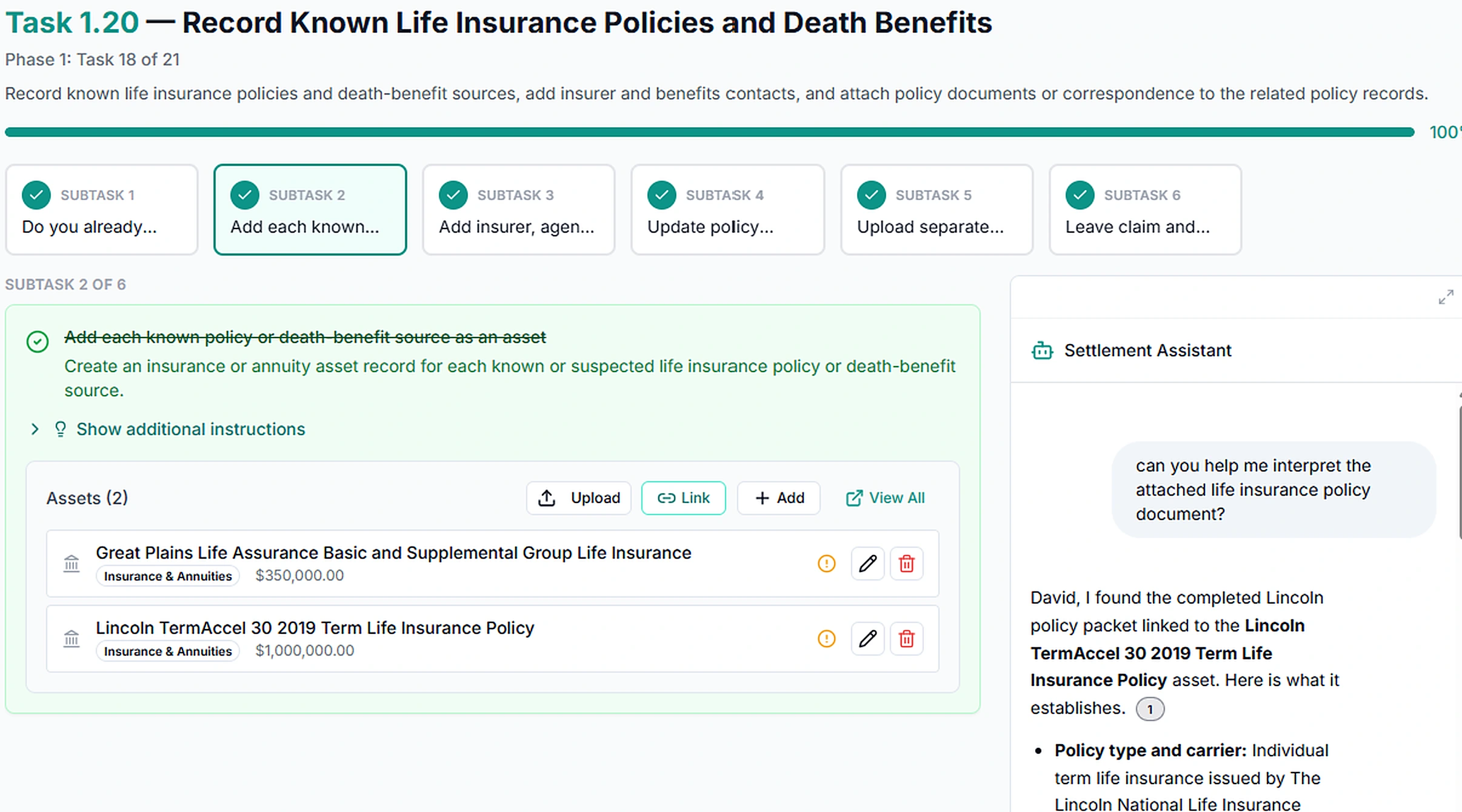
A better settlement process should reduce both kinds of uncertainty.
Adapted to the estate
The workflow should change as the estate becomes clearer.
Josda takes a different approach.
No two estates involve exactly the same property, accounts, debts, beneficiaries, family circumstances, businesses, legal structures, tax issues, or administrative needs. A static checklist has to show a broad universe of possible work and leave the user to determine what matters.
As the user answers questions and works through the estate, that information can surface relevant future tasks and remove work that does not apply. The process becomes more specific to the estate as Josda learns what the user is actually dealing with.
What the user tells Josda
Answers and estate context gathered while doing the work
What appears next
Relevant future tasks for this estate
What stays out of the way
Work that does not apply here
The family should see the work their estate requires — not every task another estate might require.
Work with the estate as you go
The information you uncover should become part of the process.
The work and the information needed to do the work should not live in separate systems.
Settling an estate generates information constantly. As the personal representative works, they identify assets and debts, people and professional relationships, documents and records, expenses, claims, property details, and other facts needed to move the estate forward.
A checklist can tell someone to gather that information. Josda lets users capture structured estate information as part of the work itself, so information gathered during one part of Settlement can remain available as the process continues.
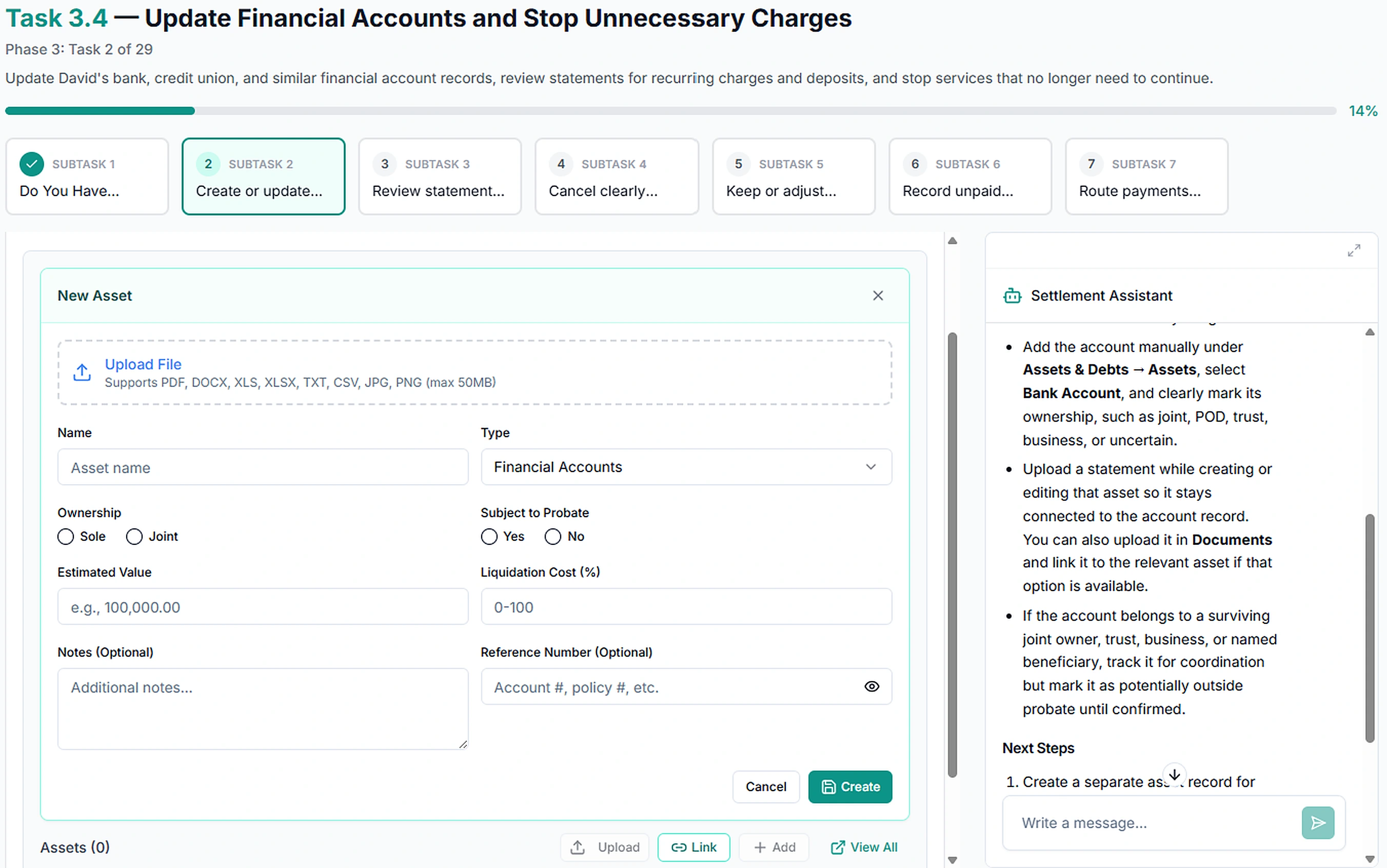
Settlement Assistant
Contextual help for the estate in front of you.
Generic information explains estate settlement. Contextual guidance helps someone settle this estate.
Generic information can explain estate settlement. But the person doing the work still has to translate that information into the estate they are actually handling. Josda’s Settlement Assistant works inside the Settlement process and can use the context of the work the user is doing and information available in Josda to help them understand a task, work through how to complete it, and keep moving.
That means the user can get help at the moment a question arises without leaving the workflow to search the internet, interpret another generic checklist, or make the advisor the first stop for every unfamiliar step.
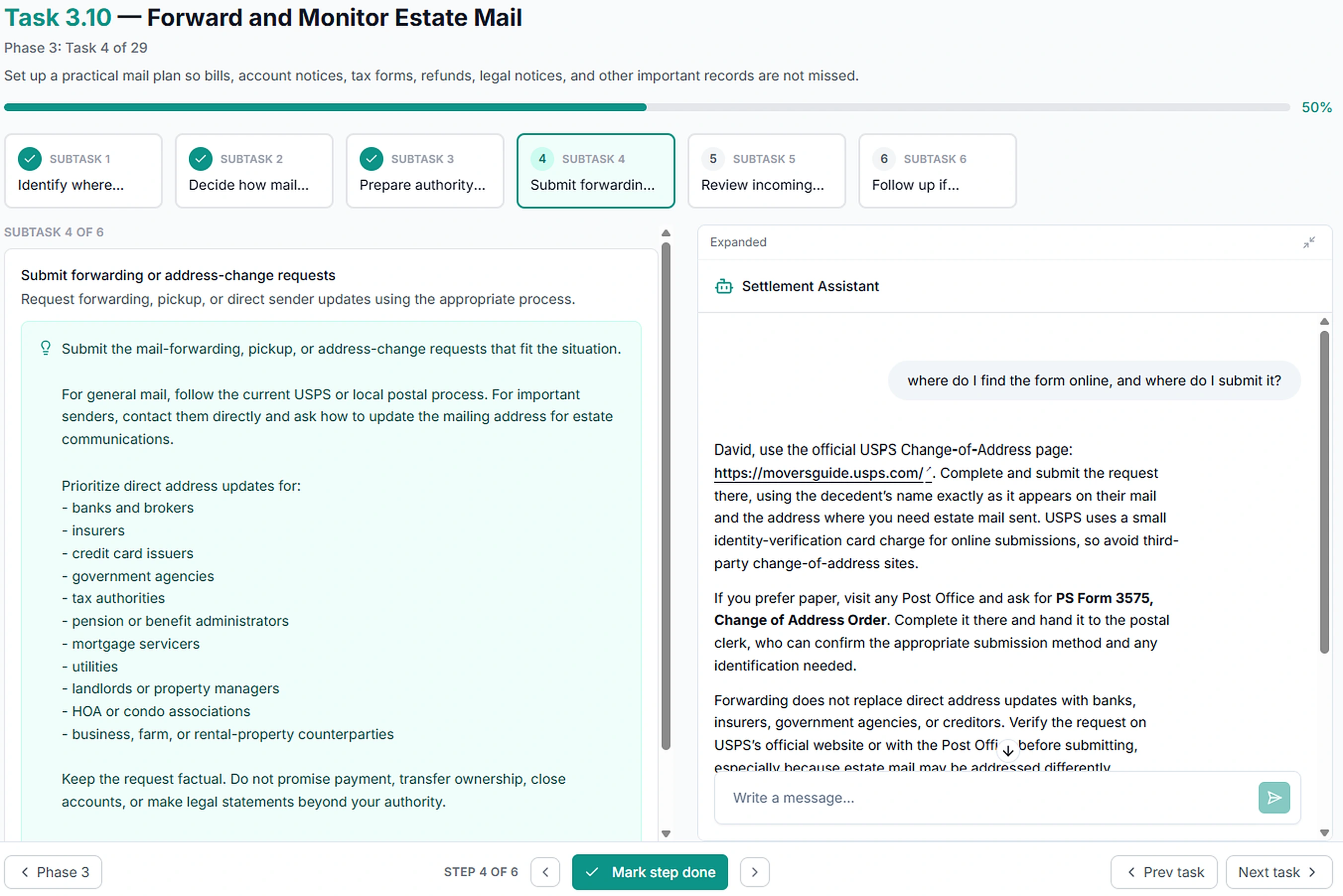
The Settlement Assistant supports the administrative process. It does not replace attorneys, accountants, financial advisors, or other professionals when legal, tax, investment, or other professional judgment is required.
The Settlement Assistant operates within the Josda environment, where customer information is handled under the platform’s security and privacy controls.
The right help at the right time
Better tools should make professional help more useful — not try to replace it.
Professional judgment remains with the professionals responsible for providing it.
Estate settlement can involve attorneys, accountants, financial advisors, insurance professionals, valuation specialists, real estate professionals, and others. A good settlement process should help the person responsible understand when specialized expertise matters and arrive at those conversations better organized.
Josda handles the structure around the work: what applies, what comes next, information gathered along the way, procedural guidance, and progress through the process. For an advisor, that can mean a client or family comes back with a clearer financial question instead of expecting the firm to organize the entire estate administration.
Josda
Helps structure and guide the process.
Personal representative
Does the settlement work.
Professionals
Provide specialized judgment and expertise.
The better organized the process is, the more useful each professional can be.
Support without taking over
Give the family more support without putting the settlement on the advisor’s desk.
Without a purpose-built process, helping someone settle an estate can easily become a stream of emails, phone calls, spreadsheets, referrals, status questions, and procedural questions the advisor was never meant to manage.
Josda gives the person responsible their own guided environment for doing the work.
The advisor can stay available where the firm adds real value — financial accounts, investments, insurance, liquidity, family decisions, and coordination with other professionals — without becoming responsible for moving every settlement task forward.
The goal is not to make the advisor the estate administrator. It is to make the advisor more useful without making the advisor the process.
Family continuity
Be useful before the family has to decide who they trust.
That transition is also a moment when the family needs real help.
When a client dies, financial responsibility often shifts quickly to a spouse, child, executor, trustee, heir, or another person who may have had little previous relationship with the advisor.
Josda gives the firm something practical to offer: a structured Settlement process for the work the family actually has to do, with the advisor remaining available where financial expertise matters. The relationship with the next generation can begin through usefulness rather than a request to retain assets.
Multigenerational relationships are stronger when the family already knows why the advisor is useful.
From preparation to action
Planning prepares the estate. Settlement helps someone act on it.
The better the estate is prepared during life, the less the family should have to rediscover after death.
Josda Planning helps households organize the financial, practical, and family information around the estate, identify what deserves attention, and improve readiness while they are living. Josda Settlement gives the person responsible a guided process for working through the estate when responsibility becomes real.
The connection matters because one of the hardest parts of settlement is reconstructing a financial and practical life after the person who understood it best is no longer there to explain it.
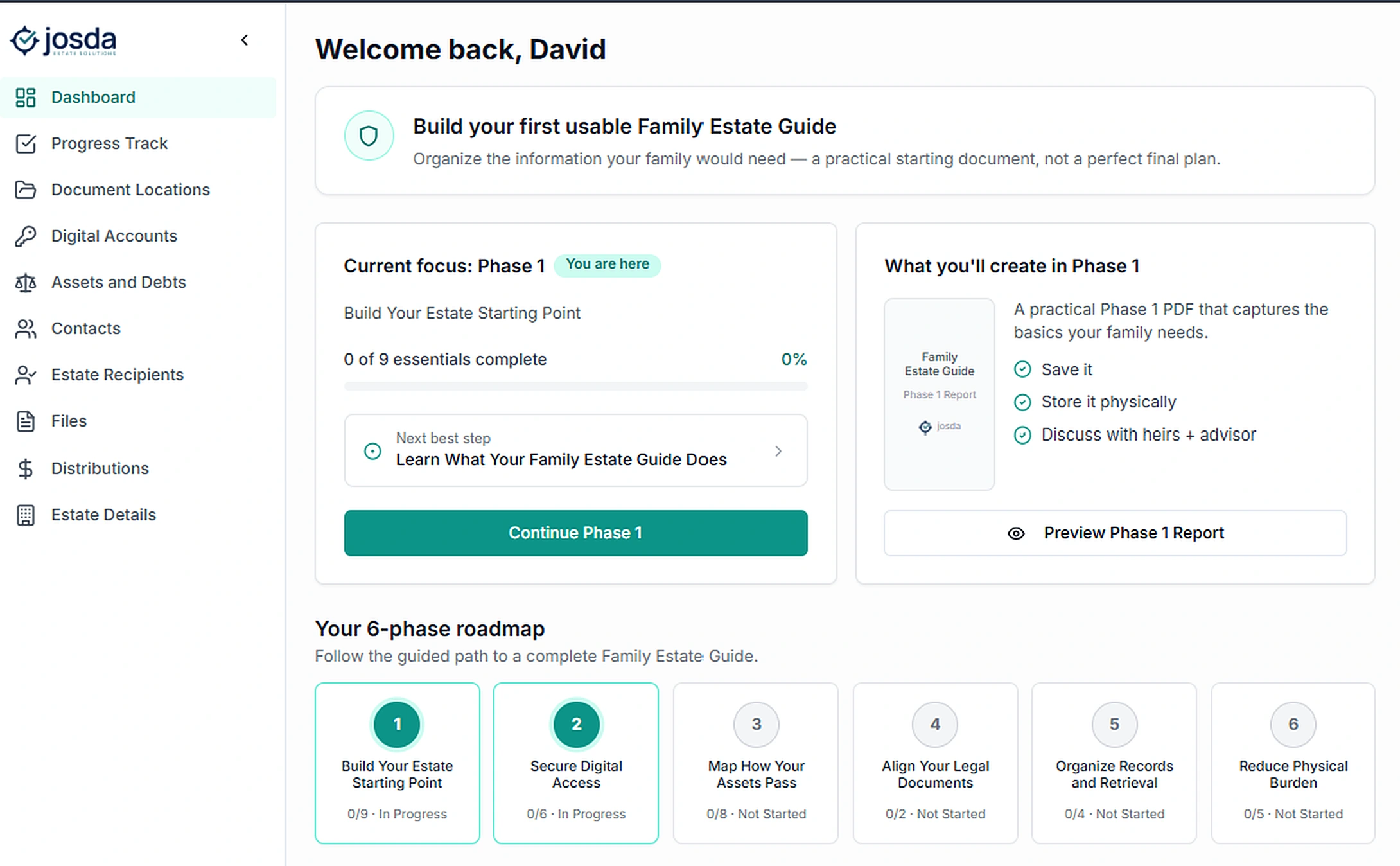
Settling an estate can involve financial details, estate records, uploaded documents, personal information, and other sensitive information about the person who died and the people involved.
Security and privacy are built into how Josda is operated, how access is controlled, and how customer information is handled.
Encrypted in transit and at rest
Restricted production access
Customer personal information is not used to train Josda's own AI models
Give clients and families a better way through estate settlement.
Josda gives advisory firms a purpose-built Settlement capability they can put directly into the hands of the people doing the work — with adaptive guidance, contextual help, and a clearer path through what comes next.