
Josda Planning
The plan may be written. The estate keeps changing.
A will, trust, power of attorney, and healthcare directive establish important parts of an estate plan. But the accounts, ownership, beneficiary designations, insurance, records, digital access, people, and other practical information around them continue to change.
Josda Planning gives households and advisors a structured way to build that broader estate picture, identify what deserves attention, take useful action, and keep the work useful as life changes.
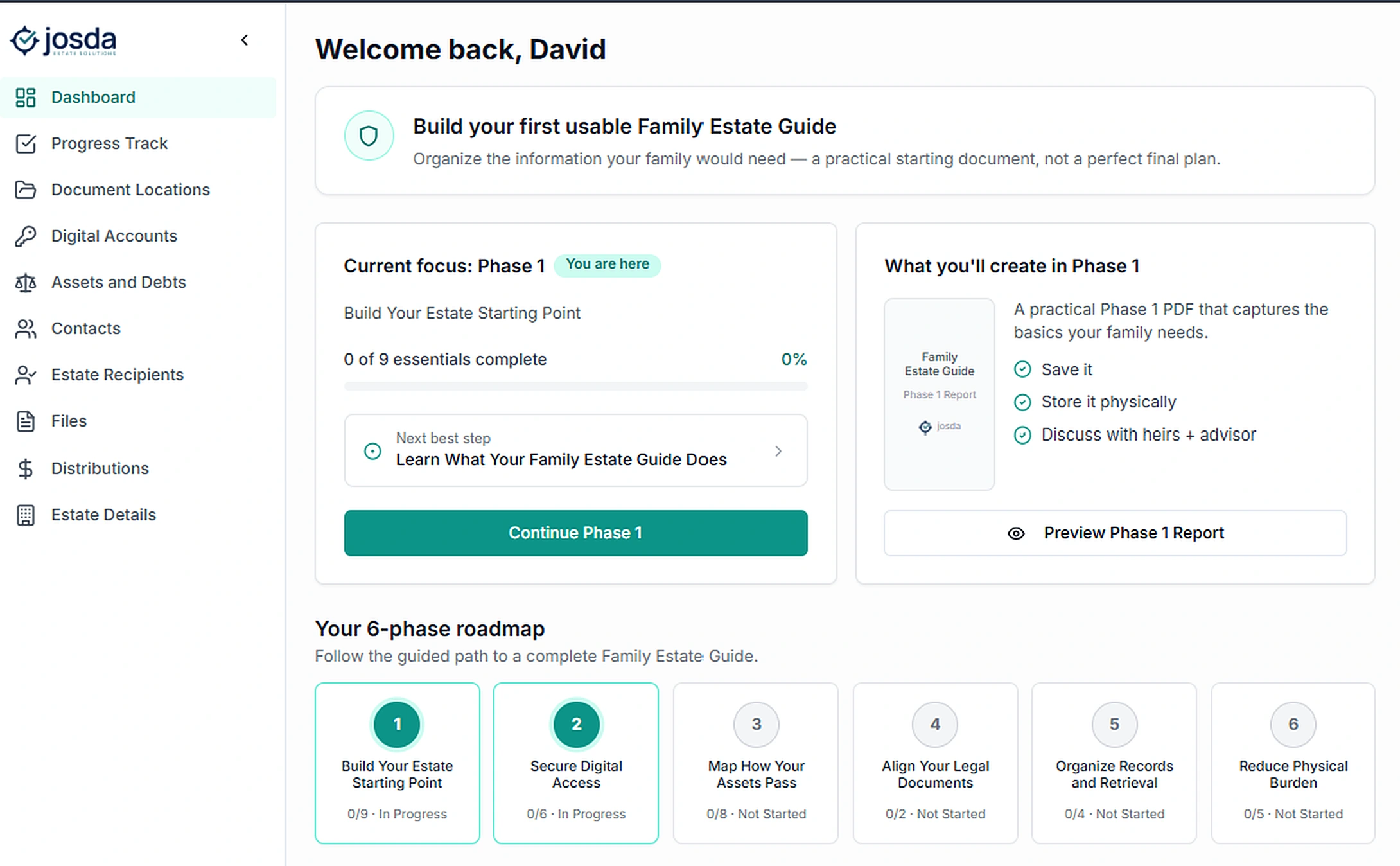
Ongoing planning
Make estate planning part of the ongoing planning relationship.
A will, trust, power of attorney, and healthcare directive may be completed at a particular point in time. But the estate around them keeps changing — accounts, ownership, beneficiaries, insurance, family roles, important records, digital access, and the client’s broader financial life.
Estate planning works better when those issues can become part of normal planning conversations instead of a separate project the client has to restart every few years — or a worksheet the client completes once and everyone hopes remains useful.
Josda gives advisors a practical way to make that happen: help clients do more of the work with less effort, preserve what has already been completed, and return to the estate picture as circumstances change.
The goal is to make holistic estate planning easier to bring into the planning relationship, easier for clients to do, and more useful while they are living.
Josda can fit into an advisor’s existing planning cadence or be revisited when a meaningful change in the client’s life creates a reason to take another look.
A better standard
If estate planning is going to become part of the ongoing planning relationship, the process has to meet a higher standard.
It is not enough to collect more information or give the client another checklist.
A useful ongoing process has to make the work easier to do, create value before everything is finished, give the advisor better context, help the client improve the estate while there is still time to act, preserve prior work, and fit naturally into the way the firm already serves clients.
Reduce the work clients have to do
The client should not have to reconstruct the estate manually or become the workflow engine for the process.
Create useful value along the way
Clients and advisors should get something useful from meaningful progress — not wait until every part of the estate is complete.
Turn information into better planning
The purpose of gathering information is not simply to create a more complete inventory. It should create better questions and better planning conversations.
Help improve the estate today
The process should surface practical work that can be clarified, organized, reviewed, or improved while the client can still act.
Build on what has already been done
When planning comes up again, the household should return to an existing estate picture rather than another blank intake.
Fit the firm's existing practice
Advisors should be able to incorporate the work into their own service model and planning cadence without creating a separate estate-planning operating system around it.
That is the standard Josda Planning is designed around.
How Josda Planning works
Make progress one useful piece at a time.
The process should become useful before the client reaches the end of it.
Estate planning can become overwhelming when the client is presented with everything at once. Josda breaks the work into manageable milestones, creates useful outputs as the client progresses, and preserves the underlying information in a broader estate picture that can be revisited over time.
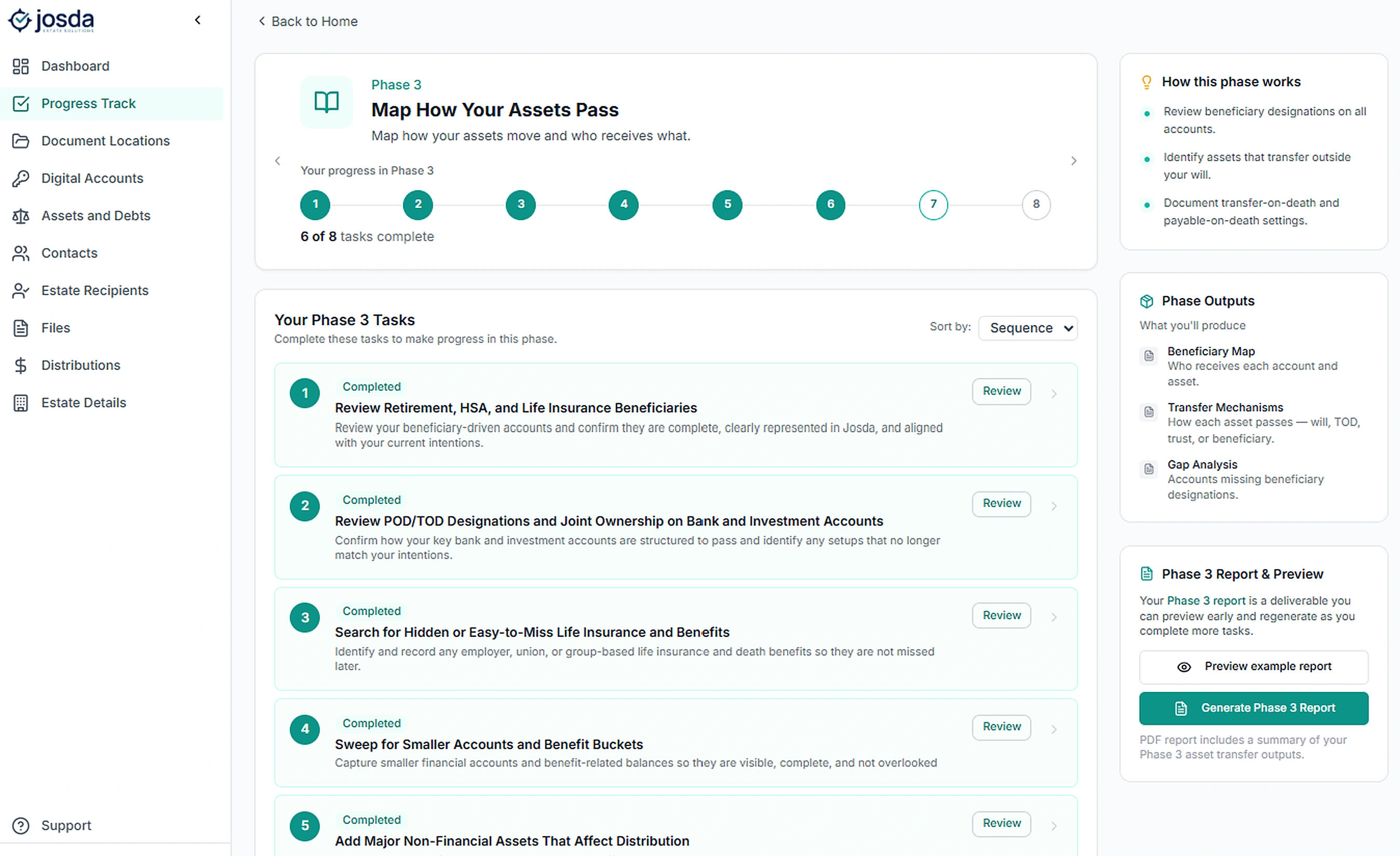
Milestones guide the work
Give the client a clear current focus and help answer: What should I work on next?
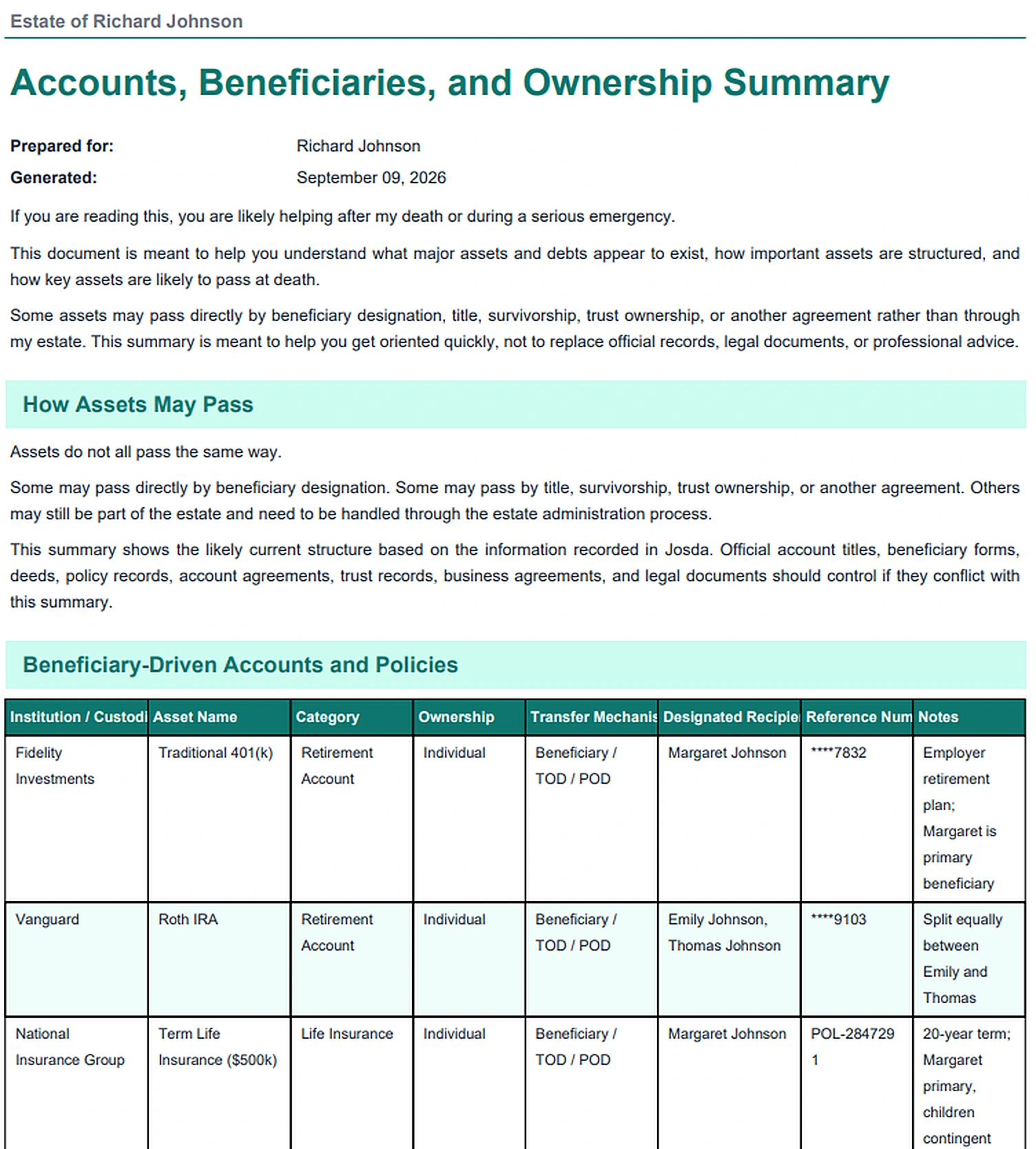
Progress creates something useful
Clients do not have to finish the entire process before the work has value. As meaningful areas are completed, Josda can create practical outputs the client and advisor can review and use — such as clearer financial-account information, organized views of key people, digital-account information, beneficiary reviews, and other planning artifacts.
The estate picture keeps building
People, assets and debts, documents, digital information, distribution information, and other completed work remain part of the household's broader estate picture for future planning.
Clients do not have to finish everything before the work becomes useful. Value accumulates as they go.
Less manual work
Use existing information to do more of the work.
A better process should use information that already exists rather than repeatedly asking the client to recreate it.
Much of the information needed for estate planning already exists somewhere — in financial accounts, transaction history, statements, legal documents, insurance records, saved digital information, and other household records.
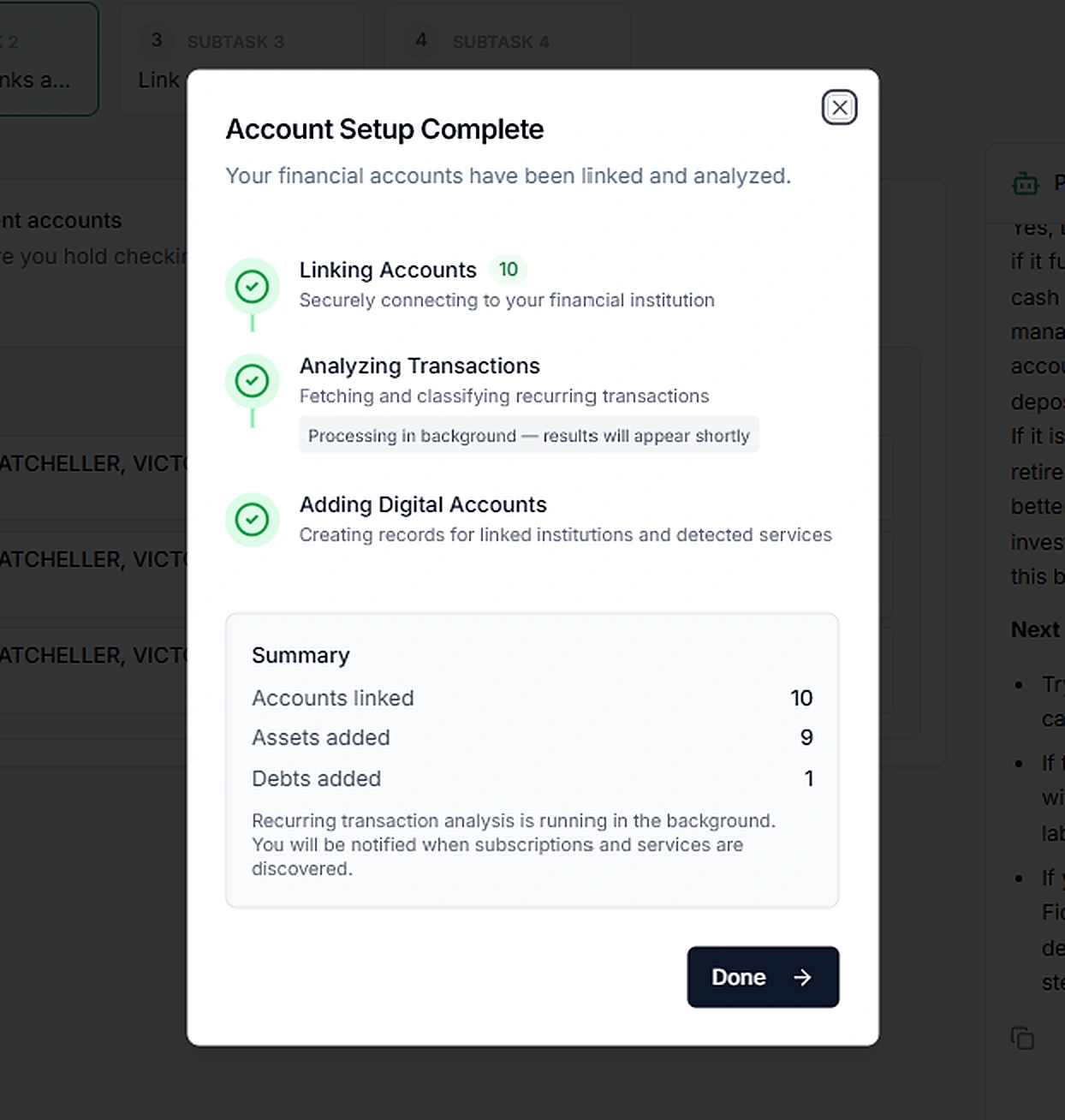
Link rather than re-enter
Clients can connect financial accounts rather than manually recreating the financial picture.
Josda can review up to two years of transaction history to surface recurring relationships and activity that may matter to the estate — including insurance, utilities, subscriptions, automatic payments, and other ongoing services.
Identified relationships can then be enriched with additional information and used to create corresponding entries inside Josda.
Import rather than recreate
Clients can bring in existing digital-account information and other structured information they already have instead of entering everything one item at a time.
Use documents as information, not just attachments
Uploaded documents can become useful context inside the planning process, allowing information the client already has to support the work rather than simply sitting in storage.
Build on what Josda already knows
Information captured or brought into Josda can remain useful elsewhere in the planning process and in future planning conversations.
The more Josda can use information the client has already provided, the less the client has to recreate by hand.
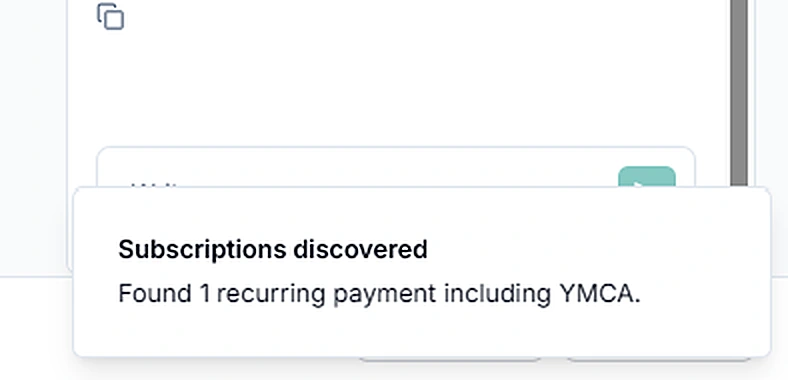
From information to planning
A clearer estate picture creates better questions.
The goal is not to create a beautifully organized inventory and stop there.
When the household’s financial structure, legal documents, family roles, insurance, records, digital access, and other practical information can be considered together, the planning conversation becomes much more useful.
Instead of simply asking whether the estate plan is “done,” the client and advisor can look more closely at how the estate is actually structured and what deserves attention.
How will the assets actually pass?
Are accounts arranged to pass through beneficiary designations, POD or TOD instructions, joint ownership, or another mechanism — and does that structure still reflect what the client intends?
Does titling support the intended outcome?
How are homes, other real estate, vehicles, and other titled property actually owned?
What happens to business interests?
How is ownership structured, what arrangements govern the interest, and what questions should be addressed with the appropriate professionals?
Are the financial and legal pieces pointing in the same direction?
Do account registrations, beneficiary designations, ownership structures, insurance arrangements, and legal documents appear to support the same intended outcome — or are there issues worth reviewing?
Could the right people actually act?
Are the people expected to serve important roles known, reachable, and equipped with the information they would need?
Better information should create better planning conversations — not simply a more complete inventory.
From review to action
A better estate-planning process should leave the estate better than it found it.
Clients are not just documenting their estate. They are improving it.
A broader estate picture often surfaces practical work that can be done now — before anyone is dealing with incapacity or death.
That might mean reviewing or adding beneficiary, POD, or TOD arrangements where appropriate; following up on how property or accounts are titled; examining ownership and succession questions around real estate or business interests; organizing insurance and employer benefits; establishing digital legacy settings; identifying the people and professionals who may need to act; locating important records; or bringing an issue to the appropriate advisor, attorney, accountant, or other professional.
Josda helps move clients from “we should probably look at this” toward a clearer next step while leaving legal, tax, investment, and other professional decisions with the professionals responsible for them.
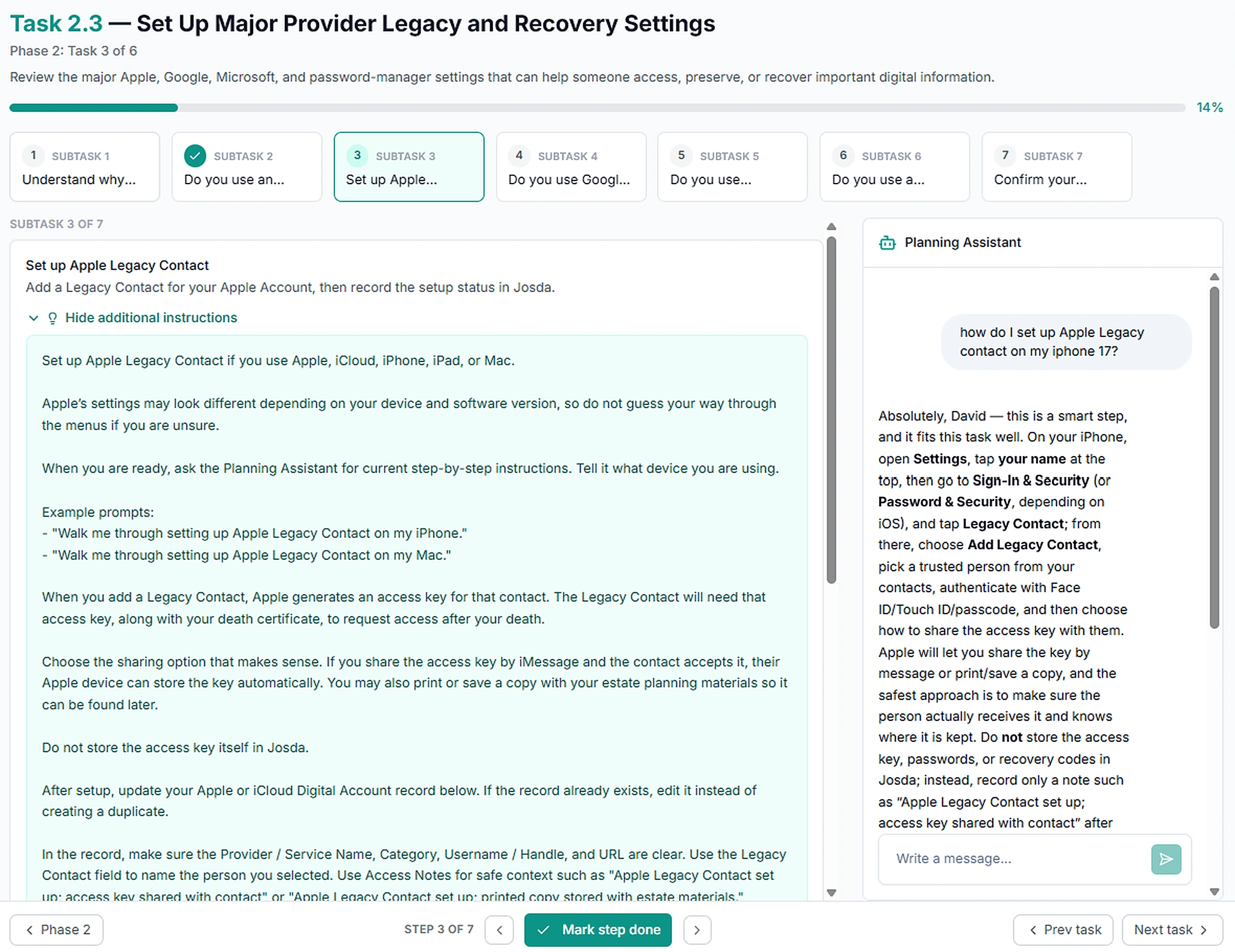
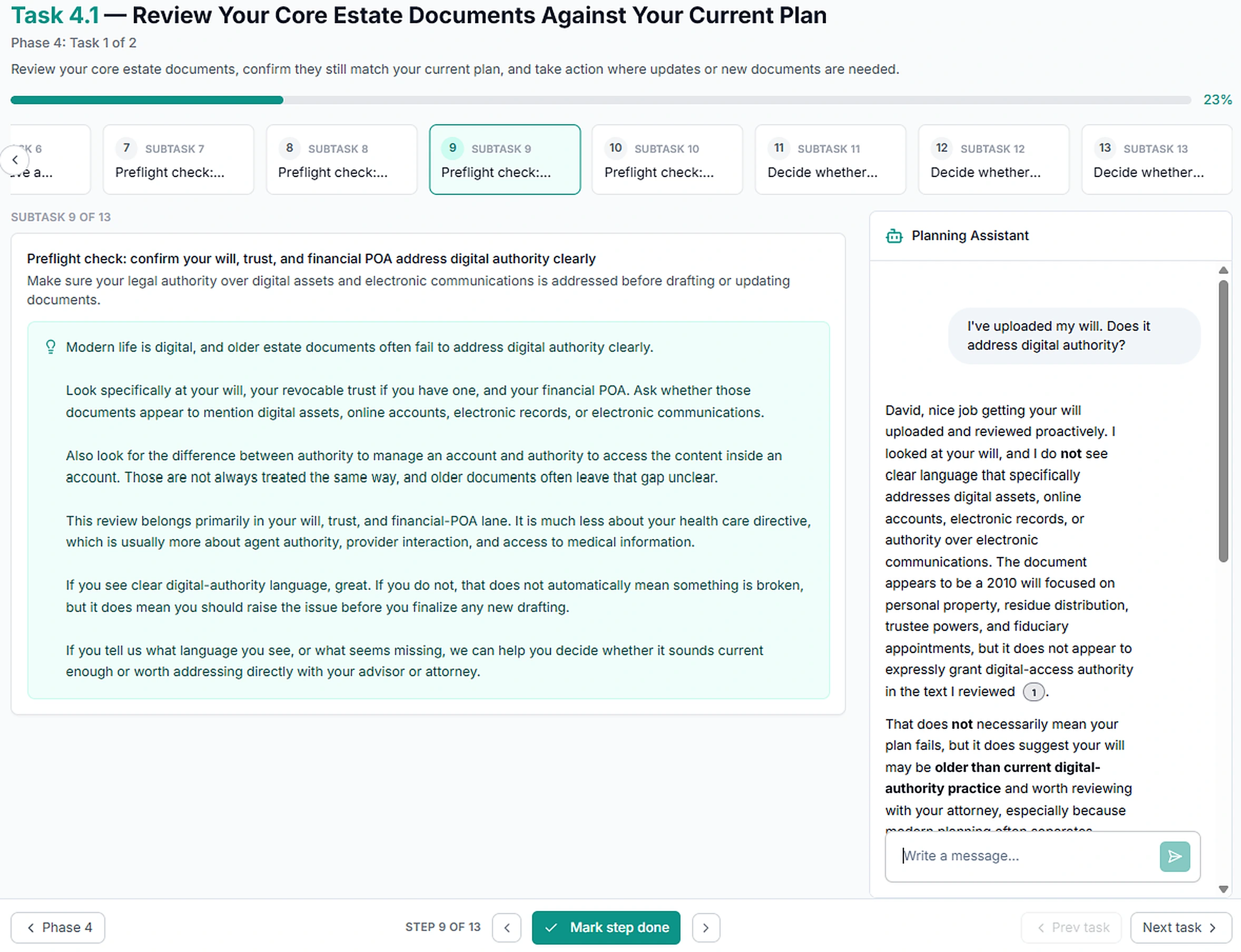
Planning Assistant
Get help without leaving the work.
If broader estate planning creates dozens of routine questions for the advisor to answer personally, it becomes difficult to scale as an ongoing service.
Estate planning asks clients to work through unfamiliar documents, financial information, family roles, digital settings, and planning concepts. When a question arises, the client should not have to leave the process and figure everything out somewhere else.
Josda’s Planning Assistant can use the context of the work the client is doing — including information and documents they have provided — to help answer questions, explain what they are looking at, and help them keep moving.
That means less friction for the client and less need for the advisor to personally answer every procedural question that arises along the way.
The client should be able to ask for help without leaving the work — and the advisor should not have to become the help desk.
The Planning Assistant supports the work. It does not replace the client’s financial advisor, attorney, accountant, or other professionals or make those professional decisions for them.
Built to be revisited
Come back to what changed — not to a blank page.
Ongoing planning should build on prior work, not recreate it.
The estate picture a household builds in Josda remains available when estate planning comes up again. When a financial, family, legal, or life change creates a reason to revisit the plan, the client and advisor can begin with the work already completed and focus attention where something has changed, something is missing, or something deserves another look.
Josda can fit into the planning rhythm a firm already has, giving advisors a practical way to bring estate planning back into the conversation without asking the client to start over.
What brings planning back
A new account, property, or business interest
A change in ownership or beneficiary designations
A marriage, divorce, birth, death, or other family change
New estate documents
Changes in insurance or benefits
Changes in the people expected to act
The firm's next estate-planning conversation
Each planning conversation can build on the work that came before it.
A useful estate picture
Turn the work into something the household can actually use.
The output of estate planning should be useful outside the software.
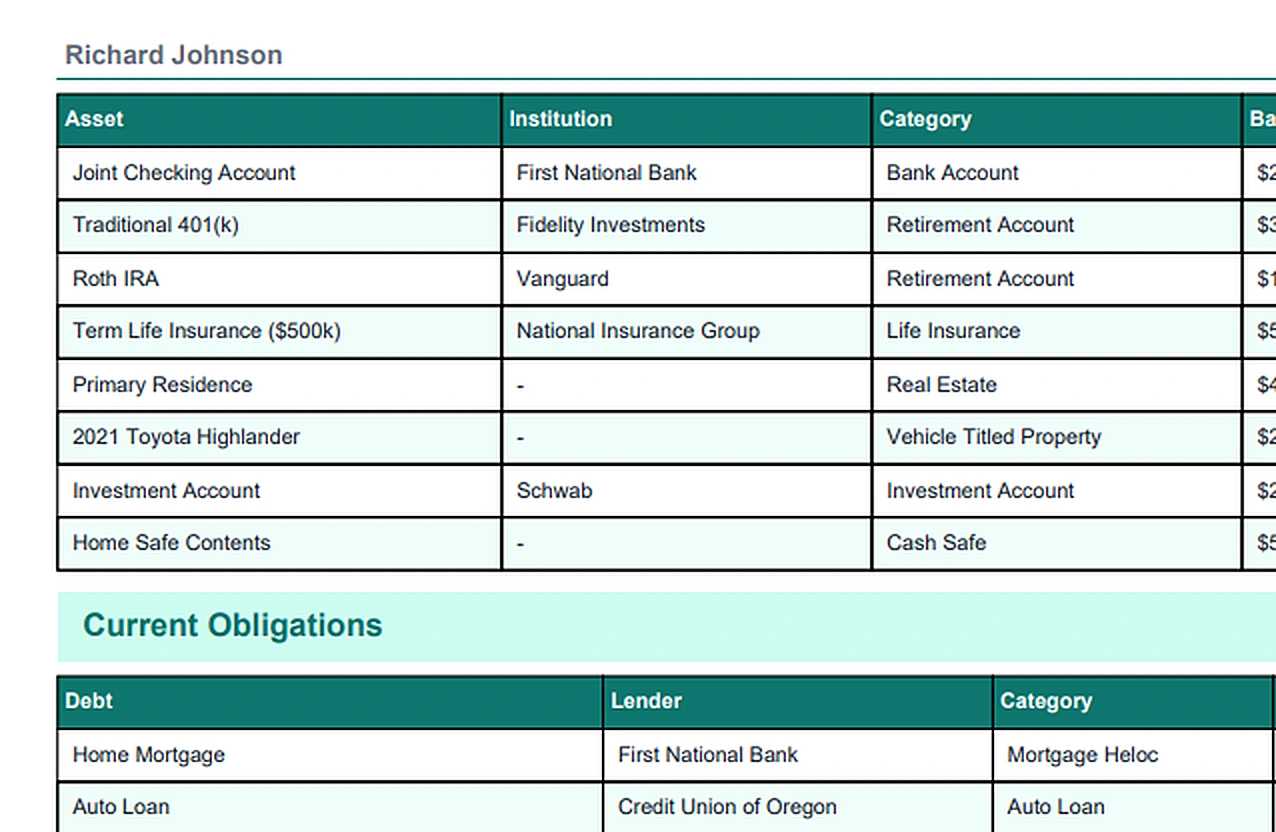
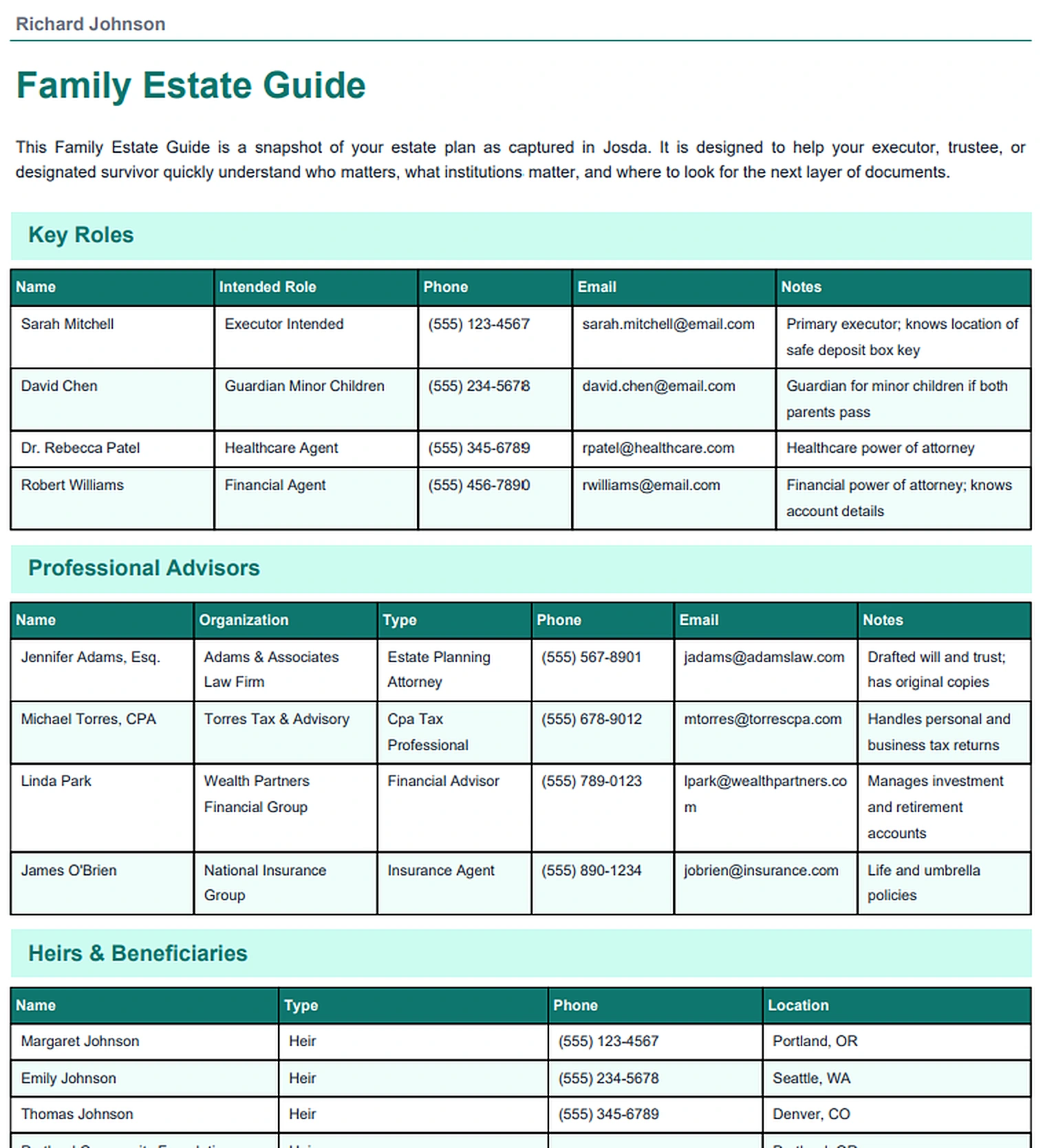
As clients progress through Josda Planning, the information and work they complete can be brought together into the Family Estate Guide — a clearer, more useful picture of the estate for the client, the advisor, and the people who may someday need to act.
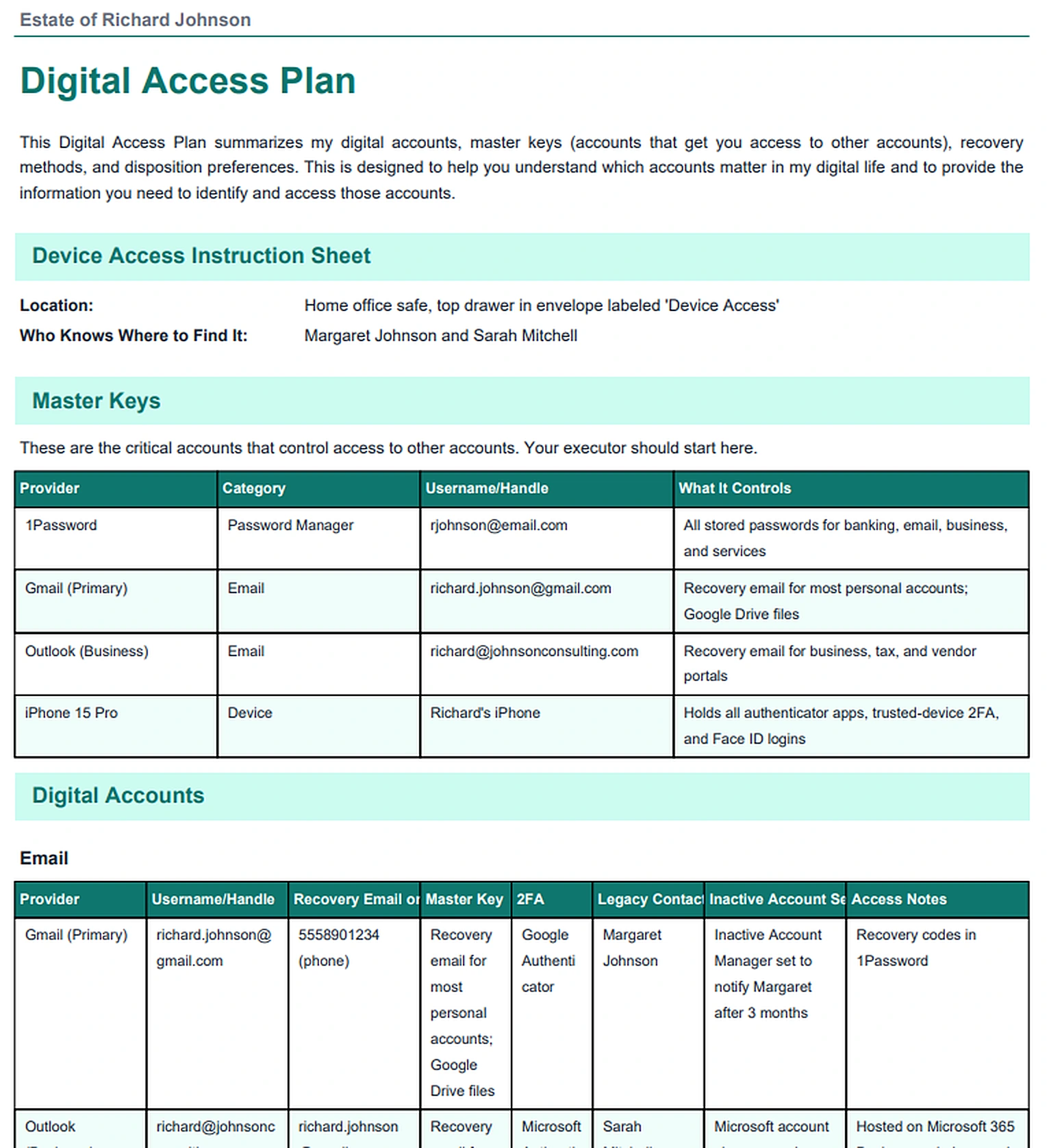
For the client
See what has been organized, understand what may still need attention, and leave behind something more useful than scattered records and disconnected accounts.
For the advisor
Give estate-planning conversations a richer, more useful starting point.
For the family
Give the people who may eventually need to step in a clearer starting point for understanding what exists, who is involved, and where important information can be found.
Clients do not have to wait until every area is complete before the work becomes useful. Individual milestones can create useful outputs along the way, while the Family Estate Guide becomes a broader picture as progress accumulates.
From planning to settlement
If the plan has to be acted on, the family is not starting from zero.
A useful planning process should leave the family with a better starting point when the plan eventually has to be acted on.
The work completed during Planning can become a valuable starting point if someone later has to act on the estate.
Accounts, assets, debts, important people, documents, insurance, practical information, and other work already organized during Planning can give the family and advisor more context when responsibility suddenly becomes real.
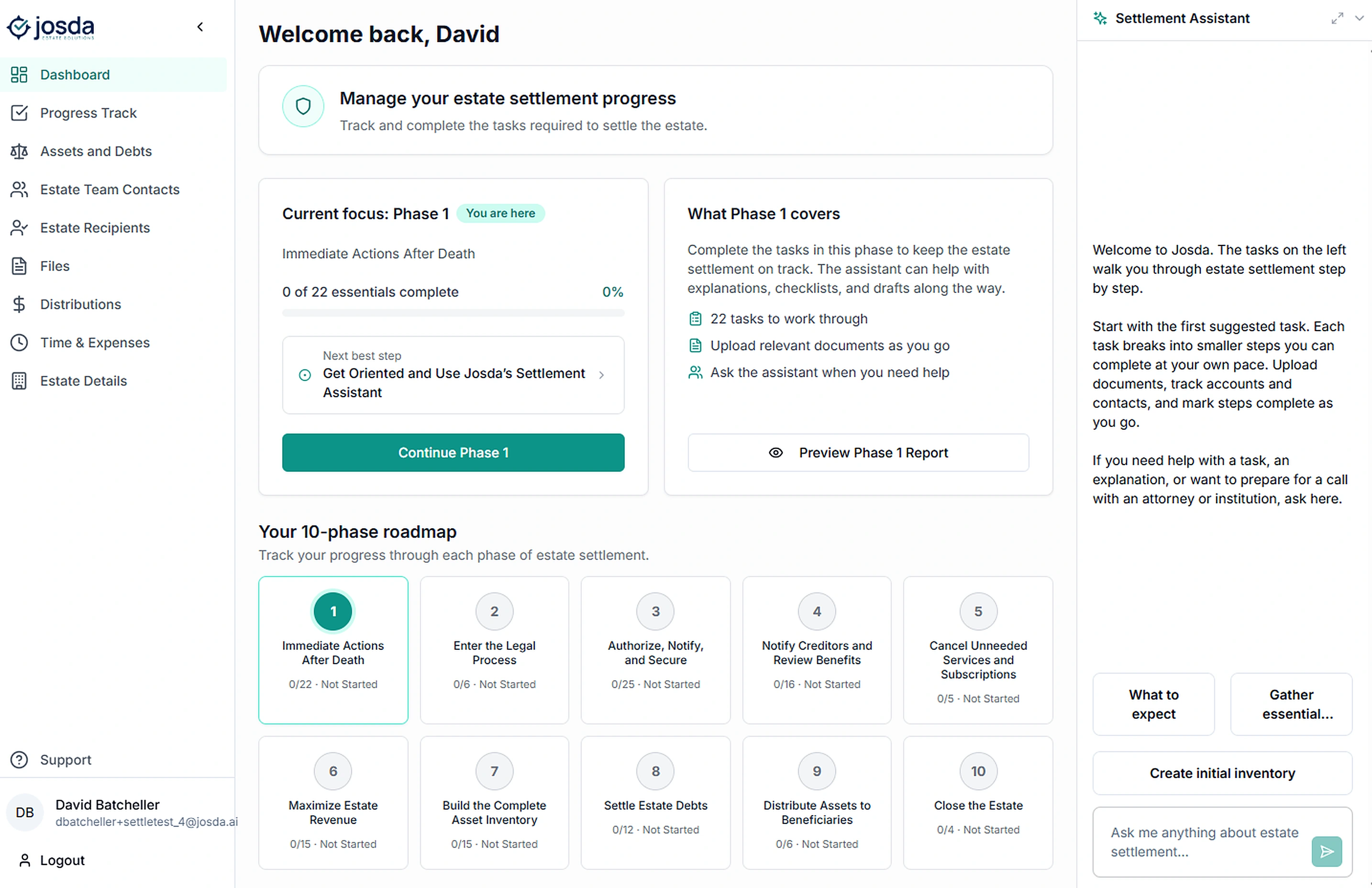
Josda Settlement builds from that foundation with a structured process designed to help the family understand what comes next and keep moving through the work.
Security & privacy
Sensitive estate information deserves serious protection.
Josda is designed to handle information that may include financial details, estate records, uploaded documents, digital-account information, and other sensitive personal information.
Security and privacy are built into how the platform is operated, how access is controlled, and how customer information is handled.
- Encrypted in transit and at rest
- Restricted production access
- Customer personal information is not used to train Josda's own AI models
See how Josda can fit into an ongoing estate-planning relationship.
Walk through the Planning experience, see how clients move through the work, and explore how Josda can support estate-planning conversations across the client relationship.