



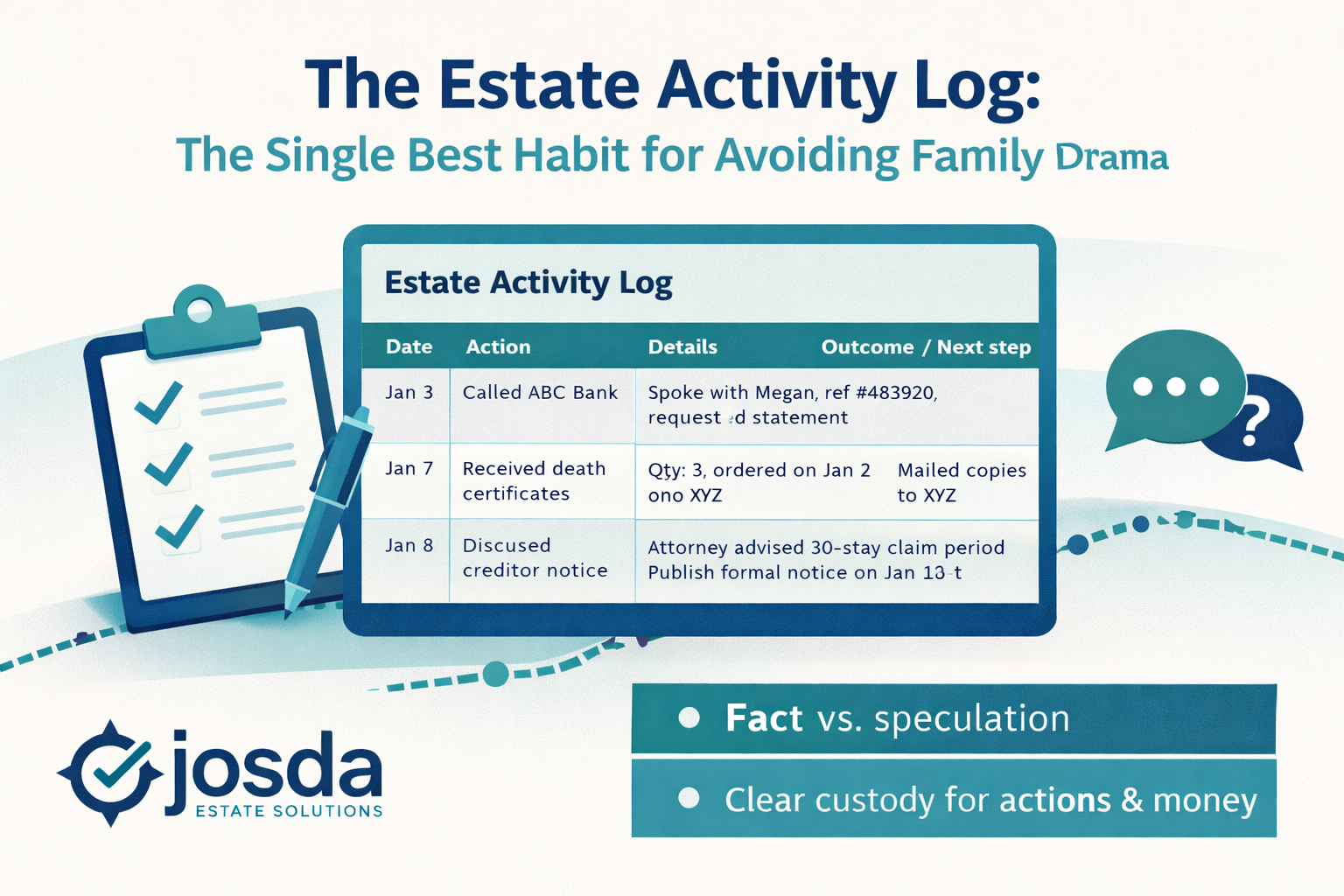
Most estate conflict is not caused by bad intent. It’s caused by uncertainty.
When families don’t know what’s happening, they fill in the blanks. They assume you’re ignoring them, hiding something, taking too long, or making decisions without input. Even reasonable people start asking pointed questions when the process feels opaque. An estate activity log solves that problem because it makes your work visible, defensible, and easy to explain.
If you adopt only one operational habit as a personal representative, executor, or trustee, make it this one.
What an estate activity log is
An estate activity log is a running record of estate-related actions and decisions. It’s not a journal. It’s not a narrative. It’s a simple timeline that answers three questions:
- What happened?
- When did it happen?
- What was the result (or next step)?
The goal is not perfection. The goal is credibility. You are building a clear chain of custody for decisions, documents, and money.
Why the log prevents drama
In an estate, there are multiple stakeholders. Some are grieving. Some are stressed. Some are watching for mistakes. And some simply don’t understand what probate or trust administration involves.
The activity log reduces conflict because it replaces opinions with facts.
Instead of “You never told us anything,” you can say, “Here’s what we’ve done since appointment, here are the open items, and here’s what we’re waiting on.” Instead of “Where did the money go?” you can point to a dated entry tied to a receipt and a bank transaction. Instead of “Why are we still not done?” you can show the unavoidable waiting periods and third-party delays.
It also protects you. If anyone later challenges a decision, questions your diligence, or accuses you of self-dealing, your best defense is contemporaneous documentation.
What to log (the practical version)
You do not need a complicated system. A Google Sheet, Notes app, or a simple document works. What matters is consistency.
Log these categories:
1) Calls and communications
- Calls with banks, creditors, insurers, employers, investment custodians
- Conversations with beneficiaries (especially when expectations or decisions are discussed)
- Emails to attorneys, accountants, realtors, appraisers
2) Documents requested and received
- Death certificates ordered and received
- Letters of appointment / letters testamentary received
- Account statements requested and received
- Appraisal orders and reports received
3) Financial actions
- Estate account opened (and where)
- Bills paid (what, why, how much)
- Deposits received (refunds, distributions to the estate, returned premiums)
- Reimbursements (what expense, whose money, documentation)
4) Decisions and rationale
- Why you chose to sell (or not sell) a home
- Why you accepted or rejected a creditor claim
- Why you delayed a distribution
- Why you hired a professional (realtor, attorney, accountant, auction company)
5) Waiting periods and external delays
- Court filing date and expected processing time
- Creditor notice dates and claim deadlines
- Tax info requests and when you’re still waiting on forms or statements
If it affects money, timing, or expectations, it goes in the log.
A simple format you can copy
Each entry should be one to three lines. Here’s a format that works:
- Date
Action: What you did
Details: Who you spoke with / reference number / documents requested
Outcome / Next step: What happened and what you’re waiting for
Example:
- Jan 3
Action: Called ABC Bank to confirm account balance and beneficiary status
Details: Spoke with “Megan,” ref #483920; requested date-of-death statement
Outcome / Next step: Statement expected in 7–10 business days; follow up Jan 15 if not received
This is boring. That’s the point. Boring is stable. Boring prevents arguments.
How often to update it
Update your log in real time when possible, or at the end of each day you work on the estate. If you wait a week, you will forget names, reference numbers, and why you made a call. Those small details become big problems later.
Consistency matters more than completeness. A “good enough” log kept steadily is more valuable than a perfect log you abandon.
The hidden benefit: it improves your speed
An activity log isn’t just protection. It speeds you up.
Estate work creates constant interruptions: waiting on mail, calls returned days later, documents arriving out of order, new issues popping up. Without a log, you waste time re-tracing steps and re-requesting documents. With a log, you always know what’s pending, what’s been handled, and what the next follow-up should be.
It is the simplest operational system you can implement that reduces both stress and cycle time.
How to use the log with beneficiaries
You do not need to share every detail. But you should use the log to create simple, periodic updates.
A practical cadence is every two to four weeks, or whenever a meaningful milestone occurs. Your update can be short:
- What we completed since the last update
- What’s in progress
- What we’re waiting on
- What’s next
That rhythm prevents the vacuum where speculation grows.
Start today, even if you’re already behind
If you’re already weeks or months into estate work, don’t overthink the past. Start now.
Make a “catch-up” entry that summarizes the major milestones you remember (court appointment date, estate account opening, major assets identified, major bills paid). Then begin logging each action going forward. A partial log is still a powerful tool.
Bottom line
Probate and estate settlement rarely fall apart because one step is hard. They fall apart because nobody can see the work, the waiting, or the rationale. An estate activity log fixes that.


.svg)
.svg)
.svg)
.svg)